
Fat Tomato becomes one of Ireland's first Slow Food Farms
A tiny hillside garden in Wexford joins a growing international network proving that you do not need acres of land to grow an extraordinary diversity of food.
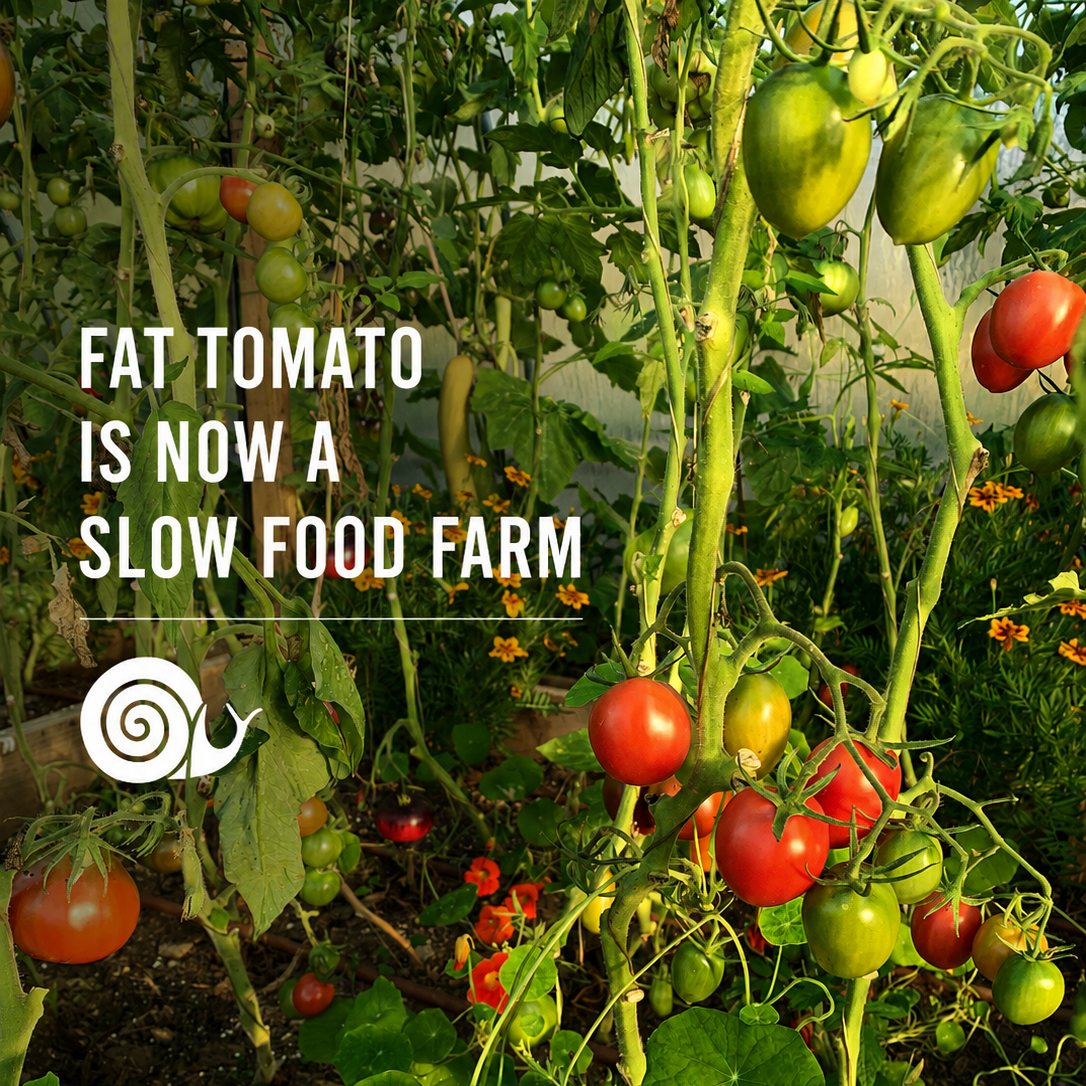
We are delighted to share that Fat Tomato has become one of the first Irish members of Slow Food Farms, a new initiative from Slow Food International connecting farms around the world committed to agroecology, biodiversity, healthy soils and food that is good, clean and fair.
For us, it feels both like an important milestone and a natural next step in a story that has been taking shape for many years.
What does a farm look like?
When we hear the word farm, we tend to imagine acres of land, tractors and large-scale production. Fat Tomato looks rather different. We grow on a tiny hillside garden in Wexford, where space, slope, weather and our particular microclimate all influence what is possible.
Yet within that relatively small patch of ground, we grow over 500 varieties of fruits, vegetables, herbs and edible flowers every year – many heritage, unusual and open-pollinated varieties you simply will not find on a supermarket shelf.
It has taught us something important: you do not necessarily need lots of land to grow an extraordinary diversity of food.
You need good soil. The right seeds. Patience and time. An understanding of your microclimate. A willingness to learn and experiment, sometimes fail and try again. And, importantly, a willingness to work with nature rather than against it.
But you also need a vision for what you are trying to create.
Growing for something other than yield
At Fat Tomato, that vision has never simply been about producing as much food as possible from the land available to us.
Flavour matters. So does biodiversity. We want heritage varieties to have a future. We save seed, grow organically without synthetic chemicals, encourage flowers and pollinators throughout the garden and grow varieties chosen for flavour rather than uniformity or yield.
That diversity ultimately shapes the food we make at Fat Tomato too. A tomato isn't simply a tomato. Different varieties of garlic, chilli, apple, cucumber or peach can have completely different flavours and characteristics.
What we cannot enjoy fresh, we preserve – capturing particular varieties and harvests in fruit butters, cordials, chutneys, pickles and other small-batch foods to enjoy long after their season has passed.
The seasons and their harvests should be savoured and celebrated, not rushed.
Coming full circle with Slow Food
For Anthony, becoming a Slow Food Farm also brings things full circle. He has been involved with the Slow Food movement for many years – hosting events in Ireland, speaking on international panels and travelling to Italy and further afield to meet growers, farmers, producers and cooks from around the world.
Those experiences brought conversations about seeds, traditional varieties, farming, biodiversity, regional food cultures and different ways of thinking about how we grow and eat.
Much of that thinking eventually found its way back to this hillside in Wexford. Joining Slow Food Farms now connects our little patch of land with a much larger international community asking many of the same questions we are. How can we grow better food? How can we protect diversity? How do we care for the soil beneath us? And how do we grow and adapt in a changing climate?
A small piece of ground. A much bigger idea.
Fat Tomato is still evolving. We want this hillside to continue becoming a place where biodiversity is protected, heritage varieties have a future and food is grown first and foremost for flavour.
But we also want it to become somewhere people can reconnect with those things – to discover varieties they have never tasted before, understand the importance of seeds and soil, experience the seasons and see just how much life and food can exist within a relatively small space.
Becoming a Slow Food Farm is another step in that journey. Because perhaps a farm doesn't have to be enormous to make a difference. Sometimes it starts with a bundle of questions, a handful of seeds, a small piece of ground and a bigger idea of what that place might become.